
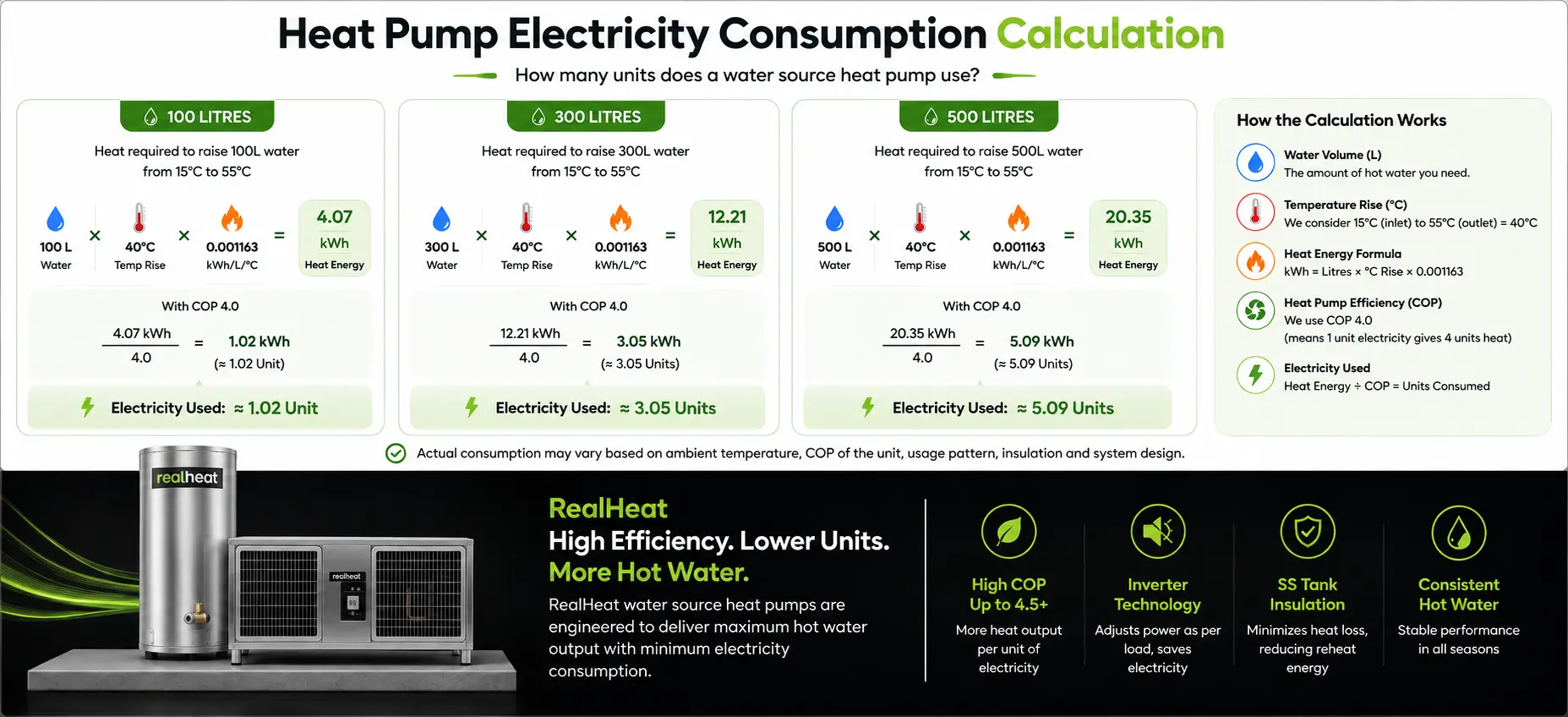
A water heat pump can use substantially less electrical energy than direct electric resistance heating because it transfers heat from the surrounding air instead of generating all of the required heat directly from electricity.
But there is no single electricity-consumption figure that applies to every installation. The amount of electricity used depends on how much water is heated, the temperature rise, ambient conditions, heat-pump COP, storage losses, circulation losses and actual hot-water usage.
Is 100 Litres ≈ 1 Electricity Unit?
It can be a useful approximate example under suitable conditions. Heating 100 litres from 30°C to 65°C requires about 4.07 kWh of thermal energy. At an example COP of 4, the theoretical electrical input is about 1.02 kWh before real-world losses.
How Is Water-Heating Energy Calculated?
First calculate the thermal energy required to increase the water temperature. The basic relationship is:
Energy = Mass × Specific Heat × Temperature Rise
For practical water calculations, 1 litre of water is approximately 1 kg.
| Calculation Input | Example |
|---|---|
| Water volume | 100 litres |
| Inlet temperature | 30°C |
| Target temperature | 65°C |
| Temperature rise | 35°C |
Example 1: Heating 100 Litres from 30°C to 65°C
The temperature rise is:
The theoretical heat energy required is approximately:
If the heat pump is operating at an example COP of 4:
Electrical Input
4.07 ÷ 4
≈ 1.02 kWhOne electricity unit equals one kilowatt-hour, so this example works out to roughly 1.02 units under the assumed conditions.
Example 2: Heating 300 Litres from 30°C to 65°C
Example 3: Heating 500 Litres from 30°C to 65°C
Quick Electricity Consumption Comparison
| Water Volume | Temperature | Thermal Energy | Example at COP 4 |
|---|---|---|---|
| 100 L | 30°C → 65°C | ≈ 4.07 kWh | ≈ 1.02 units |
| 300 L | 30°C → 65°C | ≈ 12.21 kWh | ≈ 3.05 units |
| 500 L | 30°C → 65°C | ≈ 20.35 kWh | ≈ 5.09 units |
These are theoretical examples using an assumed COP of 4. Actual electricity consumption may be higher or lower depending on ambient conditions, machine performance, tank and pipe losses, circulation and real usage.
What Is COP in a Water Heat Pump?
COP stands for Coefficient of Performance. It expresses the relationship between useful heating output and electrical input.
A COP of 4 means that, under the specified operating conditions, the heat pump delivers approximately 4 kWh of useful heat for every 1 kWh of electrical energy used by the heat-pump system.
Example only, assuming COP = 4.
What Factors Affect Heat Pump Electricity Consumption?
1. Inlet Water Temperature
Colder incoming water requires a larger temperature rise, so more thermal energy is required.
2. Required Hot-Water Temperature
Heating the same volume of water to 65°C requires more energy than heating it to 50°C.
3. Ambient Air Temperature
An air-source heat pump absorbs heat from surrounding air. Its available heating capacity and COP therefore change with ambient conditions.
4. Heat Pump COP
Higher COP means more useful heating output for each unit of electrical energy under the specified operating conditions.
5. Storage Tank Insulation
A poorly insulated storage tank loses heat more rapidly and requires more reheating.
6. Hot-Water Circulation Losses
Hotels and larger buildings often use a hot-water circulation loop. Long pipe runs and poor insulation can add meaningful heat loss.
7. Actual Hot-Water Consumption
Tank capacity and hot-water consumption are not the same thing. A 500-litre storage tank does not automatically mean that all 500 litres are reheated from cold every day.
Practical Hotel Example: 500-Litre Storage Tank
Consider a hotel using a 500-litre hot-water storage tank maintained at approximately 65°C.
If all 500 litres entered at 30°C and had to be heated to 65°C, the theoretical thermal requirement would be about 20.35 kWh.
But if guests use only 100 litres of hot water and approximately 100 litres of cold make-up water enters the storage system, the heat pump does not automatically need to reheat the full 500 litres from 30°C.
It mainly needs to restore the heat removed by hot-water usage plus storage, piping and circulation losses.
How RealHeat Estimates Electricity Consumption
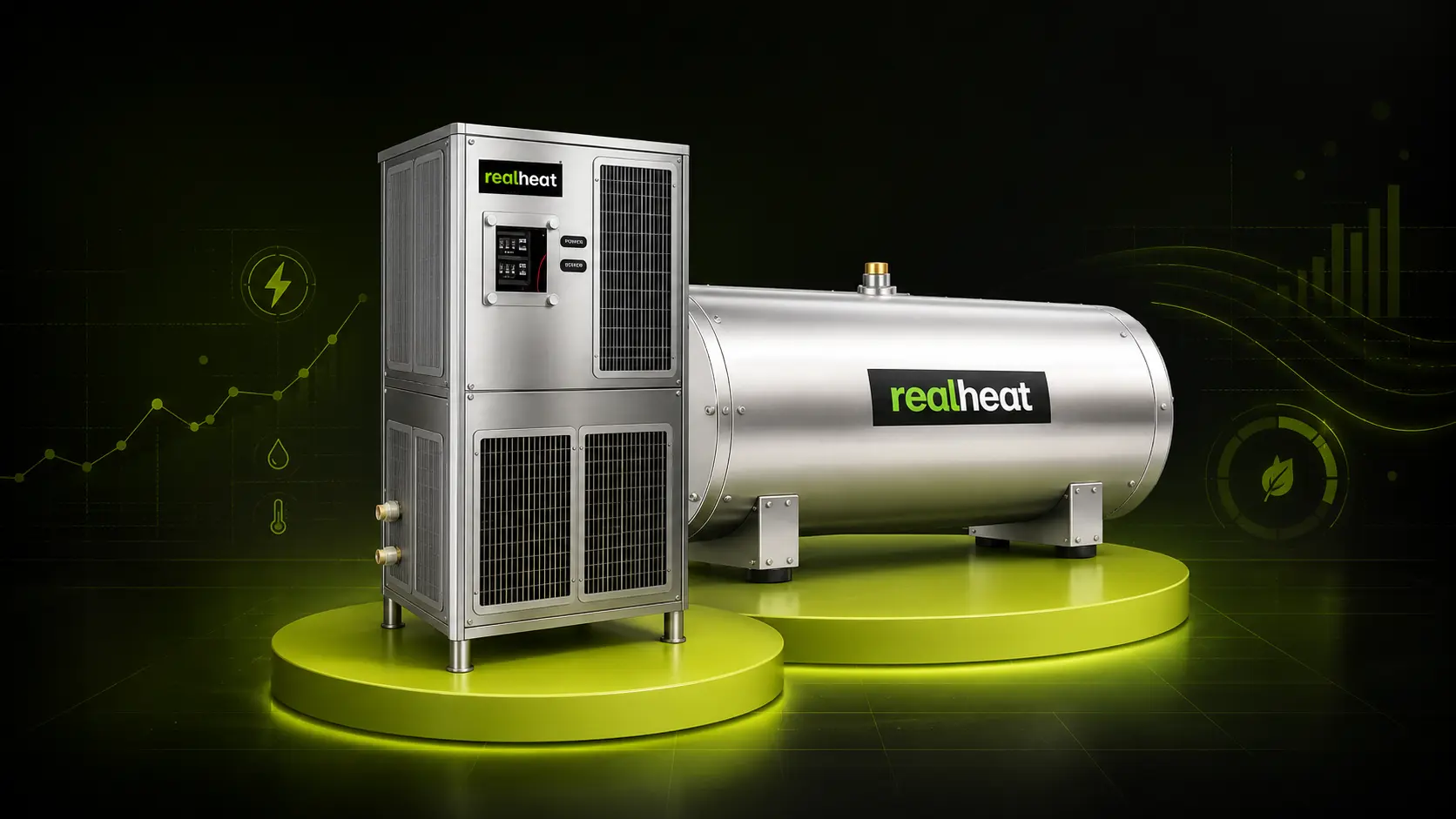
RealHeat does not select a system only from tank litres or give one fixed consumption number for every installation. The estimate is based on the actual hot-water load and the conditions under which the heat pump will operate.
Why Tank Size Alone Is Not Enough
A 500-litre tank is storage capacity, not an automatic daily electricity-consumption figure. RealHeat sizing considers the quantity of hot water actually used, make-up water temperature, peak demand and recovery requirement.
RealHeat System Selection
For homes, hotels, hostels, hospitals and other commercial applications, the heat-pump capacity and storage tank are considered together so the system can meet the required hot-water load efficiently.
Heat Pump Electricity Consumption vs Electric Geyser
A conventional electric resistance geyser converts electrical energy directly into heat. A heat pump primarily uses electricity to operate a refrigeration cycle that transfers heat from the surrounding air.
This is why a correctly selected heat pump can require substantially less electrical input for the same useful hot-water output under suitable operating conditions.
Read the detailed comparison: Water Heat Pump vs Geyser →
Frequently Asked Questions
Does 100 litres always consume 1 unit with a heat pump? +
No. Around one unit is only an approximate theoretical example for 100 litres heated from 30°C to 65°C at around COP 4. Actual consumption changes with temperature, ambient conditions, COP and system losses.
How much electricity does 500 litres require? +
Heating 500 litres from 30°C to 65°C requires about 20.35 kWh of thermal energy. At an example COP of 4, the theoretical electrical input is about 5.09 kWh before losses.
Does a 500-litre tank consume electricity for all 500 litres every day? +
Not necessarily. Daily electricity use depends on the amount of hot water actually withdrawn, the temperature of cold replacement water and heat losses from storage, pipes and circulation.
Is COP always the same? +
No. COP varies with ambient temperature, water temperatures, equipment design and other operating conditions.
Can RealHeat guarantee exactly 1 unit per 100 litres? +
No fixed figure should be guaranteed for every RealHeat installation. The 1-unit-per-100-litre example depends on the assumed temperature rise and COP. RealHeat estimates consumption according to the actual hot-water requirement and operating conditions.
Does a 500-litre RealHeat storage tank mean about 5 units every day? +
No. A 500-litre tank only describes storage capacity. If only part of the stored hot water is used, the system mainly replaces the heat removed by that usage plus normal storage and circulation losses.
What information does RealHeat need to estimate my electricity use? +
Share the number of users or rooms, shower type and flow, approximate daily and peak hot-water demand, inlet water temperature, required hot-water temperature, storage capacity and installation location.
Which RealHeat model should I choose for a 500-litre tank? +
Tank capacity alone is not enough to select the heat-pump model. RealHeat considers how quickly the hot water is used, peak demand, required recovery time, water temperatures, users and application before recommending machine capacity.
Final Takeaway
Heating 100 litres of water from 30°C to 65°C requires approximately 4.07 kWh of thermal energy. At an example COP of 4, the theoretical heat-pump electrical input is approximately 1.02 electricity units.
This makes “around 1 unit per 100 litres” a useful simplified example, but it should never be treated as a universal fixed consumption figure.
For a practical RealHeat estimate, actual hot-water usage, temperature rise, peak demand, storage, circulation and operating conditions should be considered together.