
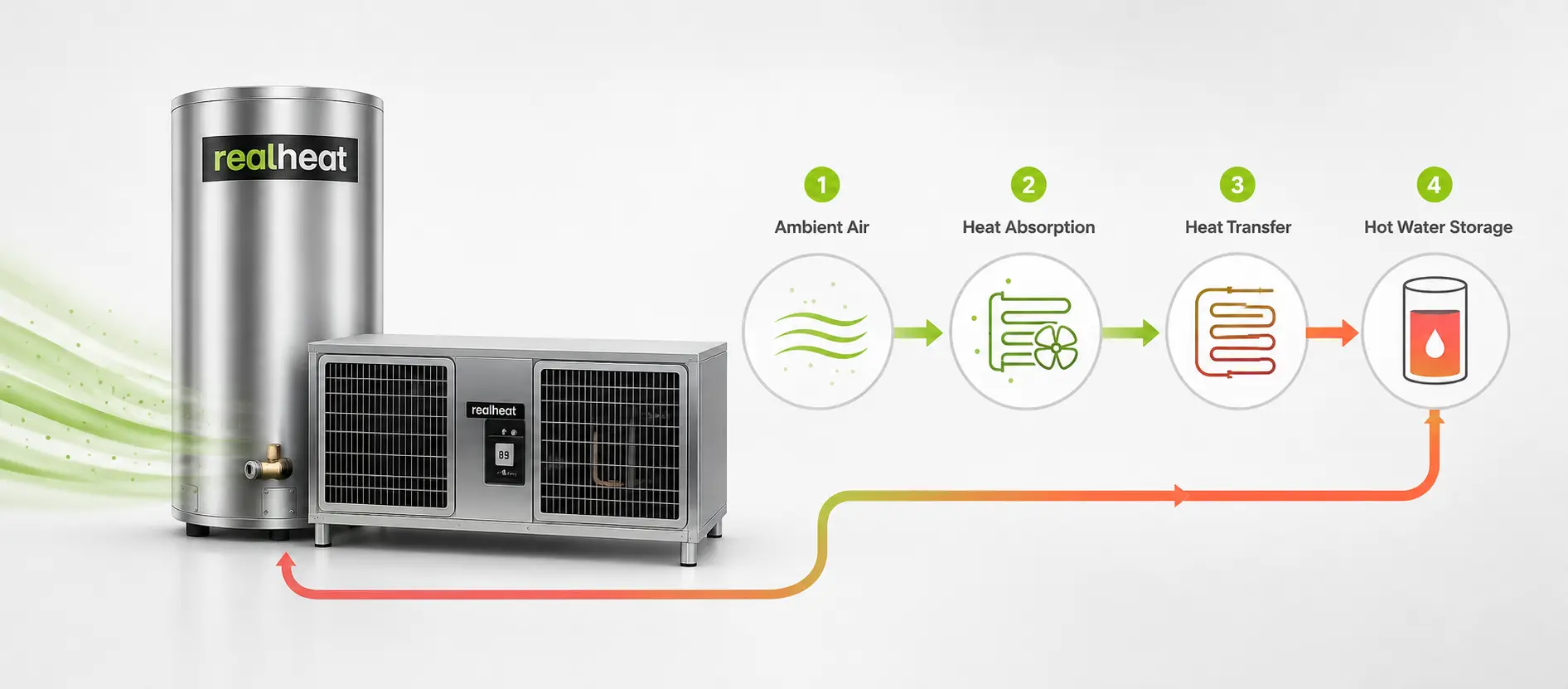
A water heat pump is an energy-efficient water heating system that transfers thermal energy from the surrounding environment to water instead of relying entirely on direct electrical resistance to generate heat.
In an air-to-water system, the heat pump extracts heat from ambient air, increases its temperature through a refrigeration cycle and transfers that heat to circulating water through a heat exchanger.
Simple Explanation
A conventional electric heater primarily converts electricity directly into heat. A heat pump primarily uses electricity to operate a refrigeration system that moves existing heat from the surrounding air into the water.
What Is a Water Heat Pump?
A water heat pump is a mechanical heating system designed to raise water temperature by transferring heat from another source. In an air-source water heat pump, that source is the surrounding air.
Even when outdoor air does not feel hot to us, it contains thermal energy. The heat pump's evaporator and refrigerant circuit collect part of this energy and move it to the water side of the system.
This technology can be used for both residential water heating and commercial hot-water applications , depending on the capacity of the equipment and the amount of hot water required.
How Does an Air-to-Water Heat Pump Work?
The operating principle becomes much easier to understand when we divide it into four stages.
Heat Absorption
Ambient air passes across the evaporator. Refrigerant inside the evaporator absorbs thermal energy from that air.
Compression
The compressor compresses the refrigerant, increasing its pressure and temperature.
Heat Transfer
The high-temperature refrigerant transfers its heat to water through the heat exchanger.
Refrigerant Expansion
Refrigerant pressure is reduced through the expansion device before it returns to the evaporator and the cycle repeats.
The Water Heat Pump Cycle in Simple Terms
Heat available in ambient air
Collects thermal energy
Raises pressure and temperature
Heat transfers to water
This continuous refrigeration cycle allows the system to transfer thermal energy into the water until the required water temperature or controller set point is reached.
Main Components of a Water Heat Pump
1. Evaporator
The evaporator collects heat from surrounding air. A fan typically moves air across the evaporator coil so that heat can be transferred to the refrigerant.
2. Compressor
The compressor is a central component of the refrigeration circuit. Compressing the refrigerant increases its pressure and temperature before it enters the heat-transfer section of the system.
3. Heat Exchanger
The heat exchanger transfers thermal energy from the hot refrigerant to the water circuit while keeping the two fluids separated.
4. Expansion Device
After releasing heat, the refrigerant passes through an expansion device that reduces its pressure so it can return to the evaporator.
5. Storage Tank
Many centralized water-heating installations use a separate insulated storage tank so that hot water can be stored and made available during periods of peak demand.
6. Temperature Controller
The controller monitors operating conditions and manages the system according to the desired hot-water temperature and equipment configuration.
How Is a Heat Pump Different from an Electric Water Heater?
| Factor | Water Heat Pump | Electric Resistance Heater |
|---|---|---|
| Heating principle | Transfers heat | Converts electricity directly into heat |
| Main energy source | Ambient thermal energy + electricity | Electricity |
| Typical application | Residential and centralized commercial systems | Individual or smaller hot-water requirements |
| Efficiency affected by | Ambient temperature, water temperatures and equipment design | Electrical resistance and system losses |
For a more detailed operating-cost comparison, read our upcoming guide on water heat pump vs geyser .
How Much Electricity Does a Water Heat Pump Use?
There is no single electricity-consumption number that applies to every heat pump installation.
Actual energy use depends on factors such as:
- Quantity of hot water produced
- Incoming cold-water temperature
- Required hot-water temperature
- Ambient air temperature
- Heat pump efficiency or COP
- Storage-tank insulation
- Hot-water circulation losses
- Pipe insulation
- Usage pattern and peak demand
Statements such as “100 litres always consumes exactly one electricity unit” should not be treated as a universal rule. A proper calculation needs the starting water temperature, required final temperature and actual heat-pump performance under those conditions.
We will cover this separately in our water heat pump electricity consumption guide .
Key Benefits of a Water Heat Pump
Heat is transferred from the environment rather than being generated entirely by electrical resistance.
Suitable configurations can supply multiple bathrooms or hot-water outlets from one centralized system.
Temperature controls can automatically operate the system according to the required set point.
Heat pumps can be configured for homes as well as larger commercial hot-water requirements.
Where Are Water Heat Pumps Used?
Water heat pumps are particularly useful where hot water is required regularly and in meaningful quantities.
How to Select the Right Water Heat Pump
Correct heat-pump selection should be based on actual hot-water demand instead of selecting a model only from the number of bathrooms or the storage-tank size.
Important information includes:
- Number of people using hot water
- Number of rooms or bathrooms
- Type and flow rate of showers
- Average shower duration
- Hot-water usage per person
- Simultaneous or peak-hour usage
- Incoming water temperature
- Required hot-water temperature
- Available storage capacity
- Ambient temperature
- Installation location and air ventilation
For commercial properties such as hotels, the morning peak demand can be more important than average daily consumption. The machine capacity and storage tank therefore need to be considered together.
Not Sure Which Heat Pump Capacity You Need?
Share your application, number of users, rooms, shower type and hot-water requirement. Our team can help you understand a suitable system configuration.
Get Heat Pump Guidance →Does a Heat Pump Work in Winter?
Yes, air-source heat pumps can operate in cold weather because outdoor air can still contain usable thermal energy at temperatures below what people normally consider warm.
However, heat-pump heating capacity and efficiency can change as ambient temperature changes. That is why local climate and equipment specifications should be considered when selecting a system.
Read more in our dedicated guide: Does a Water Heat Pump Work in Winter?
Engineered for Practical Hot-Water Requirements
RealHeat systems are selected according to actual hot-water demand, number of users, peak usage, shower flow, storage requirement and installation conditions — not only by tank capacity.
Share your users, rooms and hot-water requirement.
Frequently Asked Questions About Water Heat Pumps
What exactly is a water heat pump? +
A water heat pump transfers thermal energy from a source such as ambient air into water using a refrigeration cycle involving an evaporator, compressor, heat exchanger and expansion device.
Is an air-source heat pump the same as a water heater? +
Both can produce hot water, but their heating principles differ. A heat pump primarily transfers available heat through a refrigeration cycle, while a conventional electric resistance heater creates heat directly from electricity.
Can a heat pump be used for a hotel? +
Yes. Commercial heat pumps can be used for hotels and resorts, provided the machine capacity and hot-water storage are designed according to actual and peak hot-water demand.
Does a water heat pump require a storage tank? +
Many centralized systems use an insulated storage tank so that hot water generated over time is available when multiple users require it simultaneously.
Does a water heat pump work in winter? +
Air-source heat pumps can operate in winter, but their capacity and efficiency depend on ambient temperature and the design and operating range of the specific machine.
Final Thoughts
A water heat pump is not simply another type of electric water heater. It is a heat-transfer system that uses refrigeration technology to collect thermal energy from the surrounding environment and deliver that energy to water.
Its performance depends on correct equipment selection, water temperature requirements, climate, hot-water demand, storage and installation conditions.
For homeowners, hotels, hospitals, hostels, resorts and other properties with regular hot-water requirements, understanding these factors is the first step toward selecting the right system.